
Access Restricted for EU Residents
You are attempting to access a website operated by an entity not regulated in the EU. Products and services on this website do not comply with EU laws or ESMA investor-protection standards.
As an EU resident, you cannot proceed to the offshore website.
Please continue on the EU-regulated website to ensure full regulatory protection.
Thursday Jul 30 2026 03:14

8 min

Key takeaways:
Samsung Electronics reported record second-quarter earnings on Thursday, as surging demand for memory chips used in artificial intelligence servers pushed both revenue and operating profit to unprecedented levels.
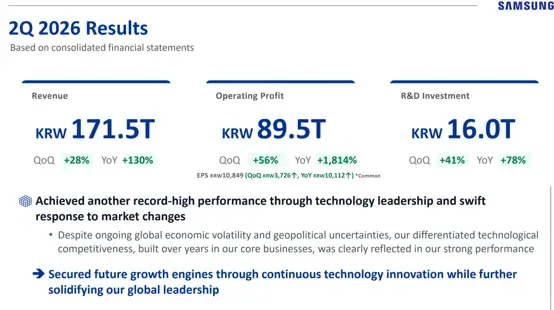
Consolidated revenue for the three months ended June 30 rose 130% year over year and 28% from the previous quarter to KRW 171.5 trillion. The figure was slightly below the KRW 172.65 trillion estimated by LSEG SmartEstimates.
Operating profit jumped 1,814% from a year earlier and 56% quarter over quarter to KRW 89.5 trillion, exceeding the LSEG estimate of KRW 88.13 trillion. The results were broadly consistent with the preliminary guidance Samsung issued earlier in July.
The latest figures marked the third consecutive quarter in which Samsung set new records for both revenue and operating profit. The company had previously reported record results in the fourth quarter of 2025 and the first quarter of 2026 as the global memory market tightened and AI-related demand accelerated.
Net profit climbed 1,299.9% year over year to KRW 71.6245 trillion, setting another quarterly record. Earnings per share for both common and preferred shares increased 52% from the previous quarter to KRW 10,849.
Samsung’s semiconductor operations were responsible for nearly all of the company’s quarterly earnings.
The Device Solutions division, which includes Samsung’s memory, foundry and system semiconductor businesses, generated revenue of KRW 127.5 trillion and operating profit of KRW 89.2 trillion. Its profit was more than 250 times the level recorded a year earlier, while revenue increased 56% from the previous quarter.
The memory business achieved record quarterly revenue and operating profit as Samsung prioritised server-related products amid limited industry capacity. Rising memory prices and strong shipments of advanced products, including high-bandwidth memory, server DRAM and enterprise solid-state drives, also supported the result.
Server products reached a record share of Samsung’s memory sales mix during the quarter. The company expanded sales of HBM4 products and said it had shipped the industry’s first HBM4E samples to major customers.
Samsung’s foundry business also reported a significant improvement in underlying earnings, supported by stronger demand for HBM base dies and orders from US customers. The company said engagements involving its 2-nanometre process for high-performance computing applications continued to expand.
System LSI revenue remained stable despite seasonal weakness in flagship devices and softer mobile demand in China. Increased sales of high-volume mobile processors and image sensors helped the business achieve record first-half revenue.
The sharp increase in memory-chip prices that benefited Samsung’s semiconductor division placed considerable pressure on its consumer-device operations.
The Device eXperience division, which covers smartphones, televisions, home appliances and other finished products, recorded revenue of approximately KRW 48 trillion and an operating loss of around KRW 800 billion. It was the division’s first quarterly operating loss.
Samsung’s Mobile eXperience and Networks businesses generated KRW 33.2 trillion in revenue but recorded an operating loss of KRW 700 billion. Sales benefited from solid demand for the Galaxy S26 series and continued momentum in the Galaxy A range, but higher component costs weighed heavily on profitability.
The Visual Display and Digital Appliances businesses generated KRW 14.5 trillion in combined revenue and posted a small operating loss. Television sales benefited from demand linked to major sporting events, while stronger air-conditioner sales supported the appliance business. However, increased input costs reduced earnings.
Samsung Display reported revenue of KRW 7.5 trillion and operating profit of KRW 700 billion. Earnings from small and medium-sized displays improved due to healthy demand for premium mobile OLED panels, while the large-display business benefited from growth in gaming monitors.
Automotive electronics subsidiary Harman generated KRW 4.6 trillion in revenue and KRW 400 billion in operating profit. Its performance was supported by increased automotive sales and strong demand for portable audio products.
Samsung expects demand for AI-related chips to remain strong during the second half of 2026, while limited production capacity is likely to keep the memory market undersupplied.
The company said continued investment in AI infrastructure and the broader adoption of agentic AI should sustain server-focused demand. Growth in demand for server DRAM, enterprise SSDs and high-bandwidth memory is expected to accelerate as technology companies continue expanding data-centre capacity.
Samsung warned that demand from smartphones and personal computers could moderate during the period. However, stronger server demand and continued supply constraints are expected to keep overall memory availability below market requirements.
The company plans to focus production on higher-value products, including HBM4, DDR5 and SOCAMM2, while expanding its position in next-generation AI platforms. Samsung also expects supply constraints to persist despite efforts to increase output.
Its foundry division intends to ramp up production of mobile chips based on its second-generation 2-nanometre process and expand sales of products manufactured using 4-nanometre technology. Samsung is targeting double-digit foundry revenue growth in the second half as demand increases across multiple process nodes in the United States and China.
For its smartphone business, Samsung plans to rely on premium devices such as the Galaxy Z8 and Galaxy S26 series to improve its product mix and offset rising component expenses. The company also plans to introduce AI-powered experiences through new products, including intelligent eyewear.
Samsung unveiled its latest product lineup, including new foldable smartphones, in the week before the earnings announcement. It also announced an expanded strategic partnership with Broadcom covering memory and semiconductor foundry technologies.
Samsung Electronics shares experienced significant volatility following the earnings release. The stock rose as much as 4% in early trading, erased its gains and briefly turned lower before rebounding.
At the time of writing, the shares were trading at around KRW 224,000, up approximately 7% for the session. Intraday prices ranged from about KRW 202,000 to KRW 226,000.
Despite the rebound, Samsung’s shares remained more than 40% below the record high reached in June. Global semiconductor stocks have faced sustained selling pressure in recent weeks as investors question whether the enormous amount of capital being committed to AI infrastructure will generate adequate long-term returns.
Concerns about rising production capacity and intensifying competition from Chinese chipmakers have also weighed on investor sentiment. Samsung and other major memory producers are investing heavily to expand output, raising fears that the current shortage could eventually develop into excess supply.
Samsung’s results followed record quarterly earnings from domestic rival SK Hynix. However, SK Hynix’s performance fell short of exceptionally high analyst expectations, sending its shares down more than 9% and adding to volatility across South Korea’s technology sector.
Risk Warning: This article is provided for informational purposes only and does not constitute investment advice, investment research, or a recommendation to trade. The views expressed are those of the author and do not necessarily reflect the position of Markets.com. When considering shares, indices, forex (foreign exchange), and commodities for trading and price predictions, remember that trading CFDs involves a significant degree of risk and may not be suitable for all investors. Leveraged products can result in capital loss. Past performance is not indicative of future results. Before trading, ensure you fully understand the risks involved and consider your investment objectives and level of experience. Cryptocurrency CFD trading restrictions may apply depending on jurisdiction.
Latest
View all
Tuesday, 22 September 2026
4 min

Tuesday, 22 September 2026
5 min

Tuesday, 22 September 2026
4 min


 EN
EN





