Access Restricted for EU Residents
You are attempting to access a website operated by an entity not regulated in the EU. Products and services on this website do not comply with EU laws or ESMA investor-protection standards.
As an EU resident, you cannot proceed to the offshore website.
Please continue on the EU-regulated website to ensure full regulatory protection.
Friday Jul 24 2026 06:41

6 min

Oil prices edged lower on Friday, July 24, but remained close to multi-week highs as escalating Middle East tensions continued to support the market.
At the latest check, Brent crude futures were trading at approximately $100.02 per barrel, down around 0.7% from the previous close. US West Texas Intermediate crude was near $91.39 per barrel, falling approximately 0.9%.
Brent traded within a daily range of $99.59 to $101.16, while WTI moved between $91.17 and $92.81. The modest pullback followed a dramatic rally on Thursday, when Brent gained approximately 7% and closed above $100 for the first time since May.
Despite Friday’s retreat, Brent was on course to rise about 14.6% for the week, marking its fourth consecutive weekly advance. WTI was heading for an increase of approximately 11.8%.
The latest price action suggests that some traders are taking profits following Thursday’s surge. However, geopolitical risks remain elevated enough to keep both benchmarks well above their levels from the beginning of July.
The latest increase in oil prices followed reported attacks on two Saudi oil tankers in the Red Sea.
The Iran-aligned Houthi movement said it had targeted the vessels after announcing a naval blockade against Saudi Arabia. One tanker was reportedly set on fire, intensifying concerns about the security of crude shipments travelling through the region.
The Bab el-Mandeb Strait connects the Red Sea with the Indian Ocean and has become increasingly important for Saudi exports. Saudi Arabia has been redirecting crude through its east-west pipeline to the Yanbu terminal on the Red Sea coast, allowing shipments to bypass the Strait of Hormuz.
Approximately 2.5 million barrels per day of Saudi crude from Yanbu have recently been moving through Bab el-Mandeb. Any sustained disruption could force tankers to travel around the Cape of Good Hope, significantly increasing journey times, insurance costs and freight rates.
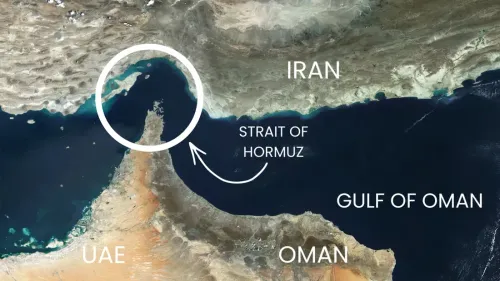
The threat to this route is particularly important because it creates a second major supply risk at a time when traffic through the Strait of Hormuz is already severely restricted.

The Strait of Hormuz normally serves as one of the world’s most important energy corridors. However, tanker traffic through the waterway has fallen sharply amid the renewed US-Iran conflict.
Ship-tracking data indicated that only one tanker crossed the strait on Thursday, the lowest number since May 7. Saudi Arabia and other Gulf producers have attempted to use alternative pipelines and export terminals, but these routes cannot fully replace Hormuz capacity.
The combination of restricted Hormuz traffic and growing security threats around Bab el-Mandeb means that both the eastern and western export routes for Gulf oil are facing pressure.
This does not necessarily mean that all affected production has been removed from the market. Nevertheless, delays, rerouting costs and uncertainty about future shipments have increased the geopolitical risk premium included in oil prices.
The situation is especially relevant to traders and businesses in the UAE and wider Middle East. Higher crude prices may support regional energy revenues, but expensive shipping, insurance and refined fuels could also raise transport and operating costs.
Oil markets are also monitoring reduced production in Kazakhstan following suspected Ukrainian drone attacks near the country’s main Black Sea export terminal.
The Caspian Pipeline Consortium suspended loadings and stopped receiving additional crude after tanker operations at the terminal were disrupted. The route normally handles approximately 2% of global daily crude supply.
Kazakhstan’s energy ministry confirmed that producers had temporarily reduced output. Although it did not provide a total figure, the country’s largest oilfield was reported to have cut production by more than half.
This disruption would ordinarily have a limited influence on global prices. Its impact is potentially greater now because it has emerged alongside supply concerns in the Gulf and Red Sea.
The immediate focus is whether Brent can remain above the psychologically important $100 level. Friday’s intraday low near $99.59 shows that the market is already testing this area.
Further attacks on tankers, a sustained blockade around Bab el-Mandeb or another decline in Hormuz traffic could renew upward pressure. Confirmation that Saudi exports are being delayed would also strengthen concerns about physical supply.
Conversely, evidence of diplomatic progress or the restoration of safer shipping routes could reduce the geopolitical premium quickly. Oil prices have already experienced sharp reversals during previous ceasefire negotiations, demonstrating how sensitive the market remains to political headlines.
Traders will also watch refinery activity. Expensive crude has encouraged some refiners to reduce processing rates, tightening supplies of diesel, petrol and jet fuel. Refined-product shortages could increase inflationary pressure even if crude prices stabilise.
For July 24, the overall oil-market picture remains volatile. Brent has pulled back slightly from its intraday high but is still trading close to $100, while WTI continues to hold above $91. Supply-route developments in the Strait of Hormuz and Bab el-Mandeb are likely to remain the main drivers of short-term price movements.
Risk Warning: This article is provided for informational purposes only and does not constitute investment advice, investment research, or a recommendation to trade. The views expressed are those of the author and do not necessarily reflect the position of Markets.com. When considering shares, indices, forex (foreign exchange), and commodities for trading and price predictions, remember that trading CFDs involves a significant degree of risk and may not be suitable for all investors. Leveraged products can result in capital loss. Past performance is not indicative of future results. Before trading, ensure you fully understand the risks involved and consider your investment objectives and level of experience. Cryptocurrency CFD trading restrictions may apply depending on jurisdiction.
Latest
View all
Thursday, 6 August 2026
5 min

Thursday, 6 August 2026
7 min

Thursday, 6 August 2026
5 min

Thursday, 6 August 2026
Indices
Gold Price Today, August 7: XAU/USD Holds Near $4,250 Before US Jobs Report

Thursday, 6 August 2026
Indices
Western Digital Stock Falls 13% and Sandisk Slides 7% as Guidance Disappoints

Thursday, 6 August 2026
Indices
SpaceX Stock Jumps 6% on $100 Billion Unlock Day as Earlier Selloff Absorbs Supply Shock

Thursday, 6 August 2026
Indices
Alphabet Stock Falls as AI Leadership Changes and $25 Billion Bond Sale Raise Spending Questions

Thursday, 6 August 2026
Indices
Tesla Stock Falls as $16.8 Billion Terafab Plan Raises Funding Questions

Thursday, 6 August 2026
Indices
AVGO Stock News Today: Broadcom Gains as AI Chip Momentum and September Earnings Move Into Focus

Thursday, 6 August 2026
Indices
US Nonfarm Payrolls Preview: Hiring Slows While Layoffs Stay Near Historic Lows


 EN
EN