
Access Restricted for EU Residents
You are attempting to access a website operated by an entity not regulated in the EU. Products and services on this website do not comply with EU laws or ESMA investor-protection standards.
As an EU resident, you cannot proceed to the offshore website.
Please continue on the EU-regulated website to ensure full regulatory protection.
Wednesday Oct 21 2026 10:25

34 min

CFD trading in UAE gives traders access to price movements in markets ranging from gold and oil to global shares and Bitcoin. A contract for difference, or CFD, can be bought when a trader expects a price to rise or sold when they expect it to fall. The trader does not own the underlying asset. That flexibility comes with substantial risk: leverage can make a relatively small market move produce a large gain or loss compared with the money placed as margin.
This guide explains what CFD trading is, which markets UAE residents can explore, how costs work, what to check in a CFD trading platform, and how to start CFD trading.
A contract for difference is an agreement to settle the change in an instrument’s price between the time a position opens and the time it closes. If a trader buys a CFD and the quoted price rises, the price change may produce a gain. If the price falls, it produces a loss. A short position works in the opposite direction: it may gain when the quoted price falls and lose when it rises.
The calculation also depends on position size and trading costs. A one-point move on a large position has a greater financial effect than the same move on a small one. The spread—the difference between the buy and sell quotes—means a newly opened position generally starts with a cost to overcome.
Consider a hypothetical CFD position with AED 10,000 of market exposure and an initial margin requirement of AED 1,000. This represents 1:10 leverage. If the instrument moves 2%, the position’s value changes by approximately AED 200 before costs.
Hypothetical market move | Approximate position result | Result relative to AED 1,000 initial margin |
|---|---|---|
Rises 2% in the position’s favour | AED 200 gain | 20% gain |
Falls 2% against the position | AED 200 loss | 20% loss |
Illustrative example only. It excludes the spread, financing, currency conversion and other charges. Actual margin requirements and results depend on the instrument and account terms.
The example shows why margin must not be mistaken for the maximum amount at risk. Profit and loss follow the AED 10,000 exposure, even though only AED 1,000 was initially required as margin. A larger adverse move can exhaust that margin. Whether an eligible account has negative balance protection is a separate question governed by its terms.
A platform can display live buy and sell quotes and allow a trader to submit an order while that instrument is available for trading. Someone searching for buying CFD real time should still distinguish a displayed quote from a guaranteed execution price.
The market may move between order submission and execution. During fast events or thin trading, the spread may widen and an order, including a stop-loss order may fill at a different price from the one requested. Some instruments trade around the clock, while others follow exchange hours or have daily breaks. Check the instrument’s live status and order details before confirming a trade.
Explore Multi-Asset CFD Trading with Markets.com
From commodities, stocks and forex to cryptocurrencies, bonds and ETFs, explore a wide range of CFD trading opportunities on Markets.com.
UAE traders often begin with markets they already follow, such as Dubai’s gold market, oil prices, major currencies or US technology shares. Familiarity with a headline, however, does not explain the terms of the CFD linked to that market.
The table provides a starting point for comparing the main categories. Actual availability depends on the provider, the account entity and the specific instrument.
CFD market | Examples | Factors and conditions to check |
|---|---|---|
Forex | EUR/USD, GBP/USD | Central bank decisions, economic data, spreads and trading hours |
Gold | Gold or XAU/USD CFDs | US dollar moves, interest rates, contract size and financing |
Oil | Brent and WTI CFDs | Supply news, geopolitical events and contract specifications |
Indices | US Tech 100, USA 500 | Major company results, market hours and the type of index CFD |
Shares | Individual global companies | Earnings, price gaps, commissions and market hours |
Crypto | Bitcoin and Ethereum CFDs | Weekend volatility, spreads and overnight costs |
A gold CFD offers exposure to the quoted price of gold without buying or storing bullion. A trader may take a long position if expecting the price to rise or a short position if expecting it to fall. Neither position gives ownership of a gold bar or a claim to physical delivery.
That distinction matters in a country where buying jewellery or investment gold is also common. A physical purchase involves considerations such as premiums, making charges and storage. A CFD has its own spread, margin and potential financing costs. Gold prices are commonly quoted in US dollars, so UAE traders should also check whether their account terms include a currency conversion charge. Our guide to trading gold in the UAE examines the gold market in more detail.
Trading hours depend on the exact product. Markets.com lists a selected Gold 24/7 CFD, but that should not be taken to mean every gold instrument on every account trades through the weekend. Confirm the live specifications for the instrument chosen.
A Bitcoin CFD follows Bitcoin price movements without requiring the trader to buy coins or manage a cryptocurrency wallet. It is one type of crypto CFD; Ethereum and other supported coins have separate contracts and may have different spreads or margin requirements.
Bitcoin can move sharply outside the working week. Markets.com describes selected Bitcoin, Ethereum and other crypto CFDs as available 24/7, making weekend trading possible on those products. Continuous access also means an open position needs monitoring when conventional share markets are closed. Spreads, funding costs and market conditions should be checked before trading. For a focused explanation, read How to Trade Crypto CFDs in the UAE.
Forex, individual shares and indices should not be assumed to follow the same schedule. For example, major forex pairs generally trade 24/5, while some selected share and index CFDs may have extended availability. The CFD asset list and live instrument conditions are the places to verify what is currently offered.
Explore Commodities, Stocks, Forex, Crypto and More
CFD services can be offered within the UAE under applicable financial-services frameworks. For a prospective trader, the useful question is more specific: which legal entity will provide the account, where is it authorised, and what activities does that authorisation cover? A brand’s international presence or UAE-focused website does not, on its own, answer those questions.
UAE regulation differs by jurisdiction. The federal Capital Market Authority (CMA) succeeded the former Securities and Commodities Authority under legislation effective January 1, 2026. The Dubai Financial Services Authority (DFSA) regulates financial services conducted in or from the Dubai International Financial Centre, while the Financial Services Regulatory Authority (FSRA) oversees financial services in Abu Dhabi Global Market. Their roles should not be treated as interchangeable.
Before funding an account, check the firm’s full legal name against the relevant regulator’s records, including the DFSA firm register or ADGM FSRA public register where applicable. Confirm the actual account provider and the scope of its permission. Then read the account agreement for the rules that apply to client money, leverage, margin close-out and negative balance protection.
Markets.com operates through different entities internationally. Its website refers to entities regulated by CySEC and the FSCA; that statement should not be read as a claim that a particular UAE resident’s account is held with a UAE-licensed entity. The applicable entity and protections must be checked during registration.
Some UAE residents also look for a swap-free account because they want to avoid overnight interest. Check whether the desired instruments qualify, whether a holding-period limit or administration fee applies, and how the account is approved. Removing an overnight swap does not remove every trading cost or settle every question about Sharia compliance. The swap-free account guide explains those distinctions.
A CFD’s advertised spread is only one part of its total cost. Before opening a position, a trader needs to understand both the money required to support it and the charges that may arise when it is opened, held or closed.
Cost or risk | How it affects a CFD position |
|---|---|
Spread | The gap between the quoted buying and selling prices |
Commission | A separate trading charge where applicable to an instrument or account |
Overnight financing | A potential charge or adjustment when a position stays open beyond the daily rollover |
Currency conversion | A possible charge when an instrument’s currency differs from the account currency |
Margin requirement | The funds needed to open and maintain the position |
Slippage | A difference between the requested and executed price during market movement |
Leverage magnifies the result relative to the initial margin. In the earlier AED 10,000 example, a 2% adverse move meant an approximately AED 200 loss before costs—20% of the AED 1,000 initially placed as margin. Increasing leverage without reducing exposure can make a normal price move consume the available margin quickly.
The margin needed to open a trade is also different from the account equity needed to keep it open. If losses reduce available funds, the platform may require more margin or close positions under its rules. A stop-loss can help define an intended exit, but a gap or rapidly moving market may prevent execution at the chosen level.
Holding time changes the calculation. A trader who opens and closes a position on the same day may focus heavily on the spread and execution. Someone holding a leveraged position for weeks must also consider cumulative financing charges. A swap-free account may alter the overnight charge on eligible products, but it can have other conditions.
For an AED-based trader considering a USD-quoted instrument, conversion terms also deserve attention. The dirham’s exchange-rate relationship with the dollar is relatively stable, but a platform can still apply a conversion charge under its account terms. Review the current Markets.com trading conditions for the selected product rather than applying one market’s costs to every CFD.
A CFD and a direct purchase can respond to the same price movement, yet give the holder different rights and costs. The appropriate choice depends on whether the goal is short-term price exposure or ownership of the asset itself.
Feature | Trading a CFD | Buying the underlying asset |
|---|---|---|
Ownership | No ownership of the underlying asset | Ownership depends on the asset and purchase method |
Rising and falling prices | Long and short positions may be available | A standard purchase principally benefits from a price rise |
Leverage | Often available, subject to terms | A cash purchase does not require CFD margin |
Ongoing costs | Financing or other holding charges may apply | Storage, custody or other asset-specific costs may apply |
Associated rights | No physical delivery or ordinary shareholder voting rights | Rights depend on whether the asset is gold, shares or crypto |
For gold, buying a bar provides possession of metal; trading a gold CFD provides exposure to a quoted price. For Bitcoin, buying coins through an exchange may allow withdrawal to a wallet; a Bitcoin CFD does not put coins in a wallet. For shares, a CFD does not confer the shareholder voting rights that can come with owning the stock.
Ownership is not automatically the less costly route, and a CFD is not automatically the more flexible choice for every person. Compare the total costs over the intended holding period, along with the rights you need. A long-term investor looking for share ownership may make a different choice from a trader planning a short-term position around an earnings release.
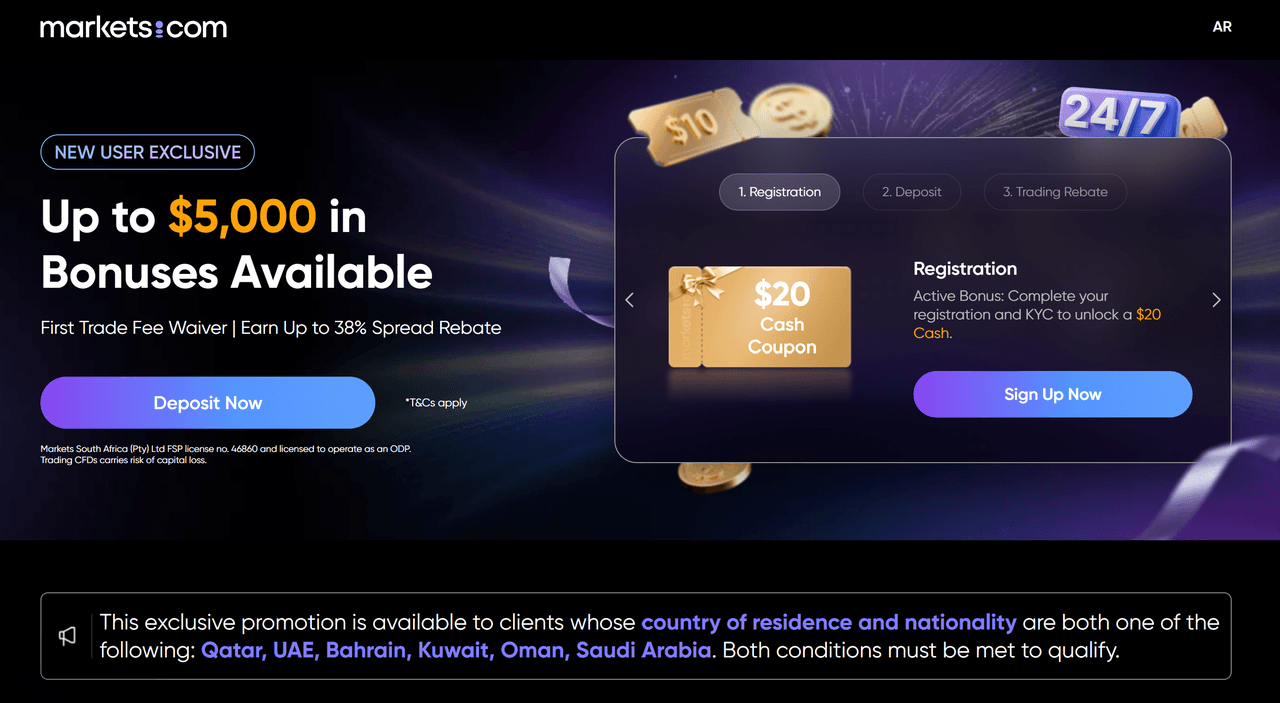
Take positions on rising or falling prices across available markets and discover up to $5,000 in combined rewards as an eligible new client. Open an account to explore the platform and available instruments today.
The best CFD trading platform UAE traders choose will depend on the markets they intend to use and the account terms available to them. Start with the provider and its regulatory position, then compare the experience and costs of trading the instruments that matter to you.
What to check | Practical question |
|---|---|
Account provider | Which legal entity will hold my account, and where can I verify its status? |
Market coverage | Are the gold, forex, Bitcoin or share CFDs I want actually available? |
Total cost | What are the spread, commission, financing and conversion terms? |
Platform | Can I use the charts, orders and mobile features comfortably? |
Risk tools | Can I set stops, monitor margin and receive price alerts? |
Trading hours | Is this specific instrument available when I intend to trade? |
Account options | Is a demo or eligible swap-free account available on suitable terms? |
A high maximum leverage figure is not a measure of platform quality. Neither is a low headline spread if the intended trade has substantial financing or conversion costs. Test the order ticket and risk tools on a demo account, and compare live specifications for the same type of instrument.
Traders who want a provider-by-provider comparison can read 10 Best CFD Trading Platforms in the UAE. That guide complements this introduction; any shortlist should still be checked against current entity and product terms.
Once the contract mechanics and risks are clear, the next step is to examine an actual platform. Markets.com offers CFDs across forex, commodities, shares, indices and crypto, with WebTrader, a mobile app, MT4 and MT5. Its UAE-facing site highlights 24/7 access on selected gold, crypto and share CFDs, and zero commission on eligible share CFD trades; spreads and other charges can still apply. Availability, leverage and account protections depend on the relevant entity and instrument.
The following steps keep the focus on checking terms and controlling exposure before placing a live trade.
Read which Markets.com entity would provide your account. Review its regulatory information, client agreement, available products and applicable protections. If a swap-free option matters to you, check its eligibility, covered instruments and possible administration fees before applying.
Create an account and complete the required identity, address and suitability checks. Funding methods and account conditions can differ by entity, so verify them in the registration process.
Use a demo to learn how the platform displays bid and ask prices, position size, margin, stop-loss orders and open profit or loss. Practising an order entry process is useful, although demo execution may not reproduce every condition encountered in live trading.

Search the CFD asset list for the instrument you intend to trade. Check whether it is the standard or a selected 24/7 product, then review its live spread, trading hours, margin and possible overnight charges.

Decide how much you can afford to lose on the idea before choosing a position size. A CFD trading calculator can help estimate margin and potential results. Check whether Buy or Sell matches your view, review the order details and consider appropriate risk controls before confirming.
Follow the relevant market events, available margin and any holding costs. Price alerts and an economic calendar can help, but they do not manage an open position for you. After closing it, compare the actual execution and total costs with the assumptions made before entry.
CFDs are leveraged instruments and can cause rapid losses. Access to weekend trading or high leverage increases flexibility, but neither reduces the need to assess position size, costs and the risk of a move against the trade.
CFD trading in UAE starts with understanding the contract rather than choosing a market from a list. Gold, Bitcoin, forex and shares may all be available through CFDs, but they differ in trading hours, volatility and holding costs. Before opening a position, identify the account provider, check the specific instrument’s terms and calculate the effect of an adverse move on the full exposure. A platform that offers suitable markets, transparent costs and usable risk tools is more valuable than an attractive headline feature used without understanding its conditions.
The questions below address common practical points that can be easy to miss when comparing products and platforms.
CFD services operate within applicable UAE financial-services frameworks. Check the specific entity offering your account and its authorisation and permitted activities. The CMA, the DFSA in the DIFC and the FSRA in ADGM have different regulatory roles; a brand name alone does not identify which rules apply to an account.
There is no useful universal figure. A platform’s minimum deposit, an instrument’s minimum trade size and its margin requirement are separate amounts. The more important limit is how much you can afford to lose if the trade goes against you, including costs.
You can submit an order against live quotes when the instrument is open for trading. The final execution price can differ from the quote seen before submission, particularly during fast markets or when liquidity is limited. Check the instrument’s trading hours as well as the current buy and sell prices.
Some platforms offer weekend Bitcoin CFD trading. Markets.com advertises selected crypto CFDs, including Bitcoin, as available 24/7. Check the product’s live status, spread and financing terms before opening or holding a weekend position.
No. A gold CFD gives exposure to movements in the quoted gold price under a contract. It does not give ownership of physical bullion or the right to take delivery of a gold bar.
A swap-free account is designed to remove overnight interest on eligible positions, subject to its terms. It may still involve spreads or administration fees. Whether a particular CFD trading arrangement meets an individual’s religious requirements involves broader questions than the overnight charge alone.
Risk Warning: This article is provided for informational purposes only and does not constitute investment advice, investment research, or a recommendation to trade. The views expressed are those of the author and do not necessarily reflect the position of Markets.com. When considering shares, indices, forex (foreign exchange), and commodities for trading and price predictions, remember that trading CFDs involves a significant degree of risk and may not be suitable for all investors. Leveraged products can result in capital loss. Past performance is not indicative of future results. Before trading, ensure you fully understand the risks involved and consider your investment objectives and level of experience. Cryptocurrency CFD trading restrictions may apply depending on jurisdiction.
Latest
View all
Monday, 26 October 2026
32 min

Monday, 26 October 2026
25 min

Monday, 26 October 2026
29 min


 EN





